
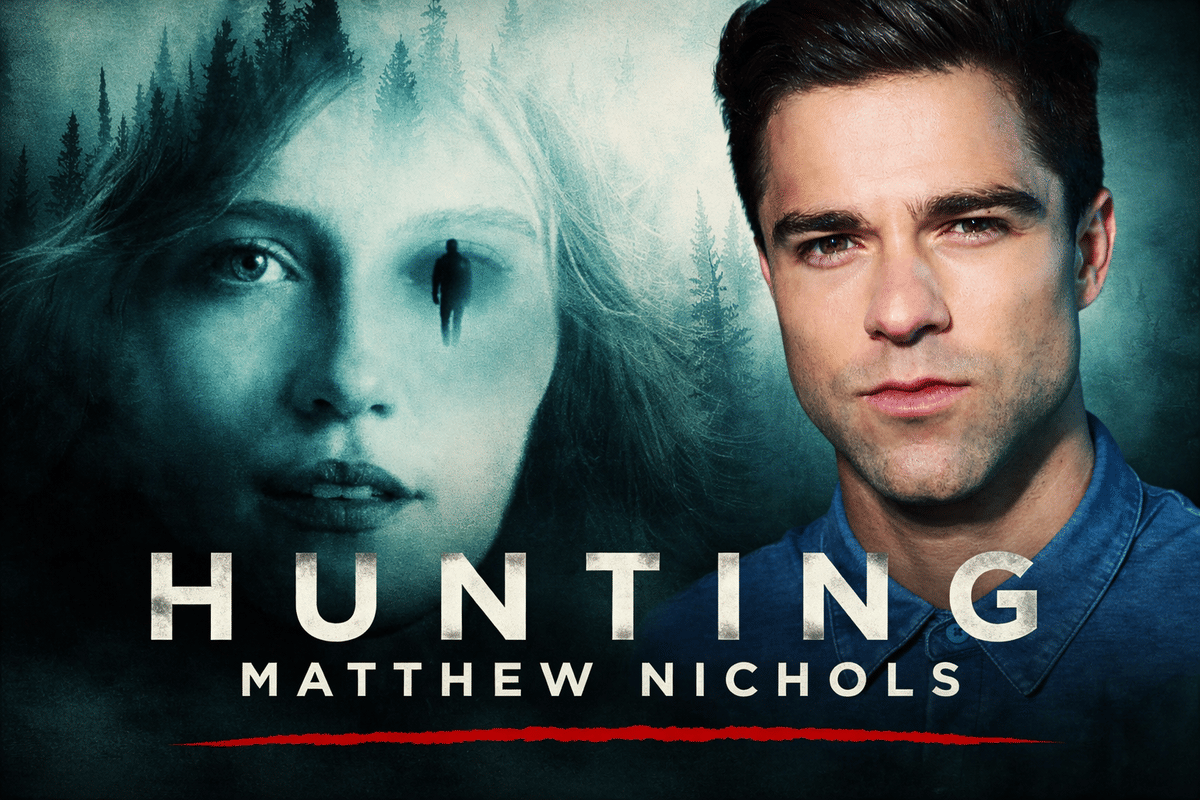
Markian Tarasiuk Talks Hunting Matthew Nichols, Found Footage Horror & Blurring Reality
A conversation about true crime inspiration, emotional storytelling, Vancouver Island, immersive marketing, and pushing creative boundaries with Hunting Matthew Nichols.
I was drawn to this story through our cultural fascination with true crime, especially missing persons cases. We are constantly being fed new true crime documentaries on streaming platforms, and they almost always end up at number one. There is clearly a huge appetite for these kinds of stories right now. That made me want to create a horror film that plays within a format audiences already recognize and trust. It was the perfect format to modernize the found footage genre.
From the very beginning, I was also really drawn to Vancouver Island as the setting. That was part of the story from day one. It was important to me to set the film in Canada and make something that felt uniquely Canadian within the horror space. Vancouver Island felt like the perfect place for that. It has nearly double the national average of missing persons cases, and when you pair that with the haunting beauty of the Pacific Northwest old growth forests, it creates a really unsettling atmosphere.
My goal with the film was to blur the line between reality and fiction as much as possible, and this setting allowed that to happen in a very natural way. It pulls you in because it feels real. I think this is the right time for a film like this because of the way audiences are engaging with this kind of content right now.
For me, it always started with treating everything as if it were real. Even though we’re blending mockumentary, found footage, and traditional narrative, the goal was never to “perform” those styles, but to fully commit to them. I wanted the audience to feel like they were uncovering something, not watching something that had been constructed for them. That carried through into every technical decision, from using cameras that were true to the time period, to relying on practical lighting, to thinking through mic placement in a way that made sense for each scene. Everything had to feel authentic, because audiences are quick to spot anything that feels off, and once that happens, you lose them.
Building that world really came down to the details. We approached the case, the characters, and the timeline the same way you would a real investigation. Every piece of footage, every interview, every document had to feel like it existed beyond the frame of the film. That meant developing backstories, allowing for inconsistencies, and even deciding what wouldn’t be shown, so it all felt grounded and real.
We also leaned into imperfections. In true crime and found footage, things are often messy, incomplete, or slightly off, and that’s what makes them believable. So instead of polishing everything, we embraced rough edges in performances, camera work, and structure. At the same time, I still wanted the film to feel cinematic, so it became a constant balance between imperfection and strong visual storytelling.
The traditional narrative elements gave us a spine to guide the audience emotionally. So while it feels like you’re piecing together a real case, there’s still a clear story underneath it all. That balance was really important to me. If the audience starts questioning what’s real and what isn’t, then I've done my job.
For me, everything started with the emotional core of the story. Tara’s search for her brother is really the backbone of the film, and I always wanted that to feel honest and grounded. If the audience doesn’t believe in her, root for her, and feel for her, then the mystery and the horror don’t land in the same way.
The way I approached it was to treat the emotional journey as the driving force, and let the mystery and horror emerge naturally from that. The deeper she goes into the investigation, the more unsettling things become. So the scares and the tension aren’t just there for effect, they are a direct result of her pushing further into something she maybe shouldn’t.
I also think restraint was important. We didn’t want to overwhelm the emotional side with constant horror beats. There are moments where you just sit with her, understand her grief, her determination, and the toll it’s taking. That way, when the film does lean into the horror, it hits harder because you’re already invested in her.
At the end of the day, it’s not just about solving a mystery. It’s about what someone is willing to risk, emotionally and psychologically, in order to find the truth. That balance between heart and fear is what really defines the film for me and I'm proud of that. Character and story will always be #1 to me and it's a trust with the audience I want to build. When you come to a film I made, you know you're going to see a hero's journey no matter the genre.
Vancouver Island had a huge influence on the tone and storytelling. It wasn’t just a backdrop, it really became a character in the film. From the beginning, I knew I wanted the environment to feel isolating, unpredictable, and a little bit unknowable, and Vancouver Island gives you that in a very real way.
There’s something about those old growth forests and the scale of them that makes you feel small. They’re incredibly beautiful, but also unsettling. You can be just a few minutes off a road and feel completely cut off. That natural atmosphere did a lot of the work for us in terms of building tension.
It also grounded the story in reality. Knowing that the island has a higher rate of missing persons cases added a layer of authenticity that fed directly into the narrative. It makes the idea of someone disappearing into that landscape feel very possible.
From a filmmaking perspective, we really leaned into what the location was giving us. We used natural light as much as possible and let the environment dictate how scenes played out. The weather, terrain, and light all became part of the storytelling, which helped everything feel more raw and immersive.
We also shot in December in BC, which ended up being essential to the look of the film. It was constantly raining, foggy, and overcast, and that atmosphere naturally fed into the sense of dread we were aiming for. Those grey and blue tones really became the visual identity of the film.
Wearing multiple hats was definitely a challenge, but it also came from a place of necessity. On an independent film like this, you’re often stepping in wherever you’re needed. The biggest challenge was switching between those roles without losing focus. As a director, you’re thinking about the bigger picture and guiding the story. As a producer, you’re solving problems and keeping everything on track. And as an actor, you have to be present and fully in the moment. Balancing those mindsets, sometimes within the same hour, was probably the toughest part.
It also meant a lot of long days and constantly shifting priorities. You’d be dealing with logistics one minute, then stepping into a scene the next, and then back to making creative decisions. It’s a bit of a mental juggling act.
One of the biggest advantages, though, came from being in the scenes with the other actors. I wanted the performances to feel as natural and real as possible, so we leaned heavily into improvisation. Being both the director and an actor allowed me to guide scenes from within. I could prompt, redirect, and push actors in real time, in a way that felt organic rather than controlled. It created a really fluid environment where moments could evolve naturally while still moving in the direction I wanted.
That approach ended up being one of the most rewarding parts of the process. It gave the performances a sense of unpredictability and authenticity that really supports the tone of the film.
Overall, being involved in every aspect of the process gave me a deep connection to the material. It allowed for a lot of creative control, but also a strong sense of collaboration, because I was so close to every department. It was challenging, but incredibly fulfilling, and it made the final result feel very personal.
I think part of it comes down to how expensive filmmaking has become. The scale of a lot of projects right now is massive, and not everyone has access to those kinds of resources. Found footage offers a way in. It’s a relatively affordable format, and it lowers the barrier to entry for filmmakers. It definitely was for me. You can focus on story, performance, and creativity without needing huge infrastructure behind you, and I think that’s really appealing right now.
At the same time, I think we’re just seeing a natural cycle. Found footage had a huge wave with films like Paranormal Activity, then it fell out of fashion for a while, and now it’s coming back again. Trends always do that. Audiences get saturated, move on, and then rediscover the format with fresh eyes.
I also think there’s a generational element to it. Gen Z hasn’t really had their own found footage cycle yet. A lot of us can point to a film that defined the format for our generation, and maybe this resurgence is that moment for a new audience. The way younger viewers consume content now, especially through social media and raw, first-person storytelling, actually lines up really well with what found footage does best.
Personally, I’ve always loved the format. When it’s done right, it can feel incredibly immediate and immersive in a way other styles don’t. It pulls the audience in and makes them feel like they’re experiencing something firsthand.
I’m excited to see where it goes next. As more filmmakers start playing in that space again, I think we’re going to see some really creative takes on it. And hopefully this film can be part of that conversation.
I was very involved in shaping the marketing, and it really started alongside the development of the script. At every stage, we were thinking about how the film could live beyond the screen and how we could build out narratives that would continue to blur the line between fiction and reality.
I knew early on that if we wanted the film to make an impact, the marketing had to be just as strong and as unique as the film itself. It had to be something audiences could engage with on its own. So we weren’t just promoting a movie, we were creating an experience around it.
I also think marketing is something a lot of filmmakers don’t think about until much later in the process. For me, it was part of the foundation. Before we even put pen to paper, I was already thinking about how this story could extend into the real world, how people could interact with it, and how we could make it feel as immersive as possible.
That approach really shaped everything. It allowed us to build a campaign that feels cohesive with the film, rather than something that sits outside of it. It’s been really gratifying to see those ideas come to life and actually connect with people. Between the staged feuds, the interactive game, and the missing persons TikToks, the campaign has started to take on a life of its own.
The decision really came from a place of belief in the film. I didn’t feel like anyone understood or valued it in the way that I did. We had conversations with distributors, but nothing that came forward reflected the potential I saw in the project. There was also a noticeable lack of creative thinking when it came to marketing. It often felt very standard, very safe, and not aligned with what we had built.
At a certain point, it became clear that no one was going to advocate for this film the way I would. No one knows the project better than the people who made it, and no one is more invested in its success. So it turned into a mindset of, if it’s not going to be done in a way that truly supports the film, then I’d rather take that on myself. There’s definitely an element of stubbornness and ego in that, but it also came from wanting to protect the integrity of what we created.
What it’s opened up has been incredibly rewarding. It’s forced us to think differently, to be more hands-on, and to engage directly with audiences in a way that traditional models don’t always allow for. It’s also highlighted some of the limitations within the current distribution system. There can be a lot of gatekeeping, and sometimes projects that don’t fit neatly into a box get overlooked.
My hope is that this can serve as an example that there are alternative paths. Self-distribution isn’t easy, and it’s not for everyone, but it does give filmmakers a level of control and ownership that can be really empowering. If anything, I hope it encourages other filmmakers to think outside the traditional system and trust their instincts when it comes to getting their work out into the world.
I don’t think it’s about believing what they saw as much as it is reflecting on how we consume these kinds of stories. In a lot of ways, the film is a bit of a satire of the true crime space and what it’s become. There’s a level of “trauma as entertainment” that we see in a lot of these documentaries, and I wanted to play with that.
Ideally, the audience has that feeling of being pulled in, of thinking they understand what they’re watching, and then realizing it might not be that simple. That “had me in the first half” reaction is part of the experience.
At the same time, there’s something really fun about questioning your own perception, even if it’s just for a moment. If the film can create that feeling and get people to think a little differently about what they’re watching and why they’re drawn to it, then I think it’s done its job.
I’ve learned a lot from this process. Going through every stage of it, from development to post, festivals, and distribution, gave me a much deeper understanding of how the entire industry works. It really felt like a crash course in both filmmaking and the business side of it.
I definitely made mistakes along the way, but that’s part of it. It was a bit of a trial by fire, and I think that kind of experience is invaluable. You can’t really learn this stuff in theory, you have to go through it.
Moving forward, I feel much more equipped to make smarter, more informed decisions. There’s a level of confidence that comes from having done it all once already. I’m excited to take everything I’ve learned and apply it to the next project, and to push things even further with that foundation in place.