
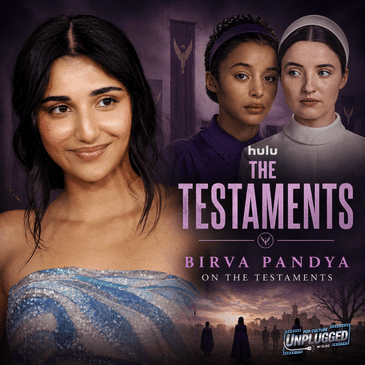
Birva Pandya joins Pop Culture Unplugged to talk about her role as Miriam in The Testaments, the highly anticipated sequel set in the world of The Handmaid’s Tale.
In this episode, Birva shares what drew her to the character, how Miriam navigates life in Gilead, and the emotional journey fans can expect. She also discusses the themes of identity, control, and sisterhood, along with how this new series brings a fresh perspective through a younger generation.
We also dive into her audition process, her approach to building Miriam’s backstory, and why certain moments in the season stand out.
If you’re a fan of The Handmaid’s Tale universe or character-driven storytelling, this is one you won’t want to miss.
Episode Highlights• Birva Pandya on playing Miriam in The Testaments
• Miriam’s emotional journey and inner conflict
• Life in Gilead from a new generation’s perspective
• Themes of identity, control, and sisterhood
• Behind-the-scenes insights and audition story
-
Watch the full interview on YouTube: https://youtu.be/Lel5E5fE56k
For more exclusive interviews and behind-the-scenes content, subscribe to Pop Culture Unplugged w/ Elias on YouTube: Subscribe here
Got a burning question or a topic suggestion? Reach out to us at popcultureunplugged@gmail.com
Stay connected with us on social media for the latest show updates
- X: https://x.com/PopCultureUnplg
- Instagram: instagram.com/popcultureunplugged
- Facebook: facebook.com/popcultureunplugged
- TikTok: tiktok.com/@popcultureunplugged
Visit our official website for more: www.popcultureunplugged.com
Subscribe to our YouTube channel for exciting content: Subscribe here
Don't miss out on the latest updates and exclusive content—join us in Pop Culture Unplugged w/ Elias!
[00:00:08] Birva Pandya, thank you for joining me today on Pop Culture Unplugged. Of course. Yeah. Thanks for having me. Congrats on The Testaments. How excited are you for an experience like this? Plus, everybody's waiting for the series to come out. I'm super excited. Yeah. I think that this has been just such an amazing experience through and through. And I feel so lucky to have been a part of the process. And I think I'm just so excited for
[00:00:36] everyone to see it because I had so much fun being a part of it and making it. What was your first thoughts when you found out you booked this role? And was it an audition process? Somebody you worked with before say, we might have a role for you. How did this happen? Yeah. So I'd given a couple auditions without knowing that it was the Handmaid's Tale Sequel. And I just really resonated with the characters. And I love the script. And I loved like playing in
[00:01:02] this imaginary world before I knew that. And so I, yeah, I just gave a couple of self tapes for it. And then they brought me on for like a callback. And then when I found out I got the role, I was so excited. I was actually in the car with some of my friends. We were heading to like a birthday party on a boat. And so I had really bad service, which was just perfect. And my team was trying to get to
[00:01:27] me to like, tell me about the news. And once I like got through with them, I was so excited. But my first thought was, what am I going to do for school? Because I'm enrolled in university. So I was like, oh my gosh, this is like such an exciting opportunity that I have to do this. And I, my mind just went straight to like, oh my gosh, what am I going to do to get out of school? Like, how am I going to manage it? But I was just filled with so much gratitude. And I just knew that it was going to be such
[00:01:54] like, an exciting journey for me and so many firsts for me too. And yeah, I was just so excited to be a part of it and to meet everybody. So as soon as you booked this, did you go back to rewatch like part of the original series or even just like clips of it just to get an idea? Yeah, I actually, I made it a very distinct choice not to do that because I loved playing in this
[00:02:24] world of like not knowing. Or even though I knew so much about The Handmaid's Tale, like I'd studied it in high school and I'd watched the show already, but I really wanted to separate it from The Handmaid's Tale because I understood it as its own like separate entity. And I didn't want to spoil that in any way. And so while I knew that it was set in the same like universe and in the same world,
[00:02:48] I wanted to treat it as a brand new thing. And I think especially for the characters, since they themselves like don't know what the world looked like before Gilead, I think that I just took a leap of faith with like trying to keep everything separate, even though I'd already known like so much about it. And even during the audition process, I really made it a habit to like try and just treat it as its own thing. Yeah.
[00:03:17] How would you say that? How would Miriam fit in this world? I think that she is someone that's very similar to me in many ways, but also very different. I think that she is very orderly and really likes the order of things. And I think Gilead has shaped her to be someone that needs to be rigid, even though she isn't.
[00:03:44] And I think something that separates her and me is she doesn't have much faith in herself and much trust in herself. And she looks to other people for like validation for approval before she herself can kind of, you know, have a solid opinion or, or judgment on something. And I think that's
[00:04:10] because the way that the system, you know, has built her is just, she's so dependent on like this foundation. And I think in many ways, like in this industry, like starting off super young, I like had this need for control. Like I feel like I needed to have a foundation and something that I can rely on, but you can't have that in this industry, you know, there's no consistent like path.
[00:04:37] And so I think that I, over the years, like I've kind of learned to like, let things go. And that's something that comes a lot more naturally to me now. And I think that's something that Miriam would struggle with in this world is also like that ability to let things go and not depend on one sole thing or one sole person. Were you given a description for this character? And the reason I'm asking is like, did you have a chance to like to play this character the way you
[00:05:05] want it? Or did you get like a little backstory to help you also? Yeah, I think it was a bit of both. I mean, I knew that was one of the plum girls that was really struggling with like marriage season. And, you know, the rituals one might say to like become a wife. And she was really struggling with the competition of it because there is like this inherent competition with these girls,
[00:05:30] even though they are like such like close friends, that's not something that's encouraged in Gilead. And it's something that's come out of like, despite of the circumstances in the world that they're in. And so I think that I was able to have creative freedom when it came to like being on set in terms
[00:05:54] of like finding a backstory for my character. I think the aspect of like her parentage and like where she came from was something that I definitely brought up to question. Yeah. And I think that it really allowed I think that's something that allowed everybody to kind of navigate and discover as we went through the season. And it's what makes I think the show feel so real is like every character
[00:06:20] does have a backstory, even though they're shown and presented to be this like one uniformed group of people. They are actually very authentic and very different. For you as an actor to like what aspects of Miriam did you connect with the most, would you say? Yeah, I honestly would say like her vulnerability is that I definitely very like connected to. She has some emotional moments in the show that
[00:06:50] is not something that I think she looks at as a moment of strength, but rather she views as like a moment of weakness. But I think growing up as a teenage girl and just growing up as like, you know, a woman, I feel like you're told so many times like how you're supposed to be acting and you know how you should always have a smile on your face. And I think Miriam really does believe that. But something
[00:07:14] that I myself have, you know, gone through just like growing up as a teenage teenager is just like trying to validate, like making sure that like my emotions are like, I'm able to kind of go through life expressing my emotions without judgment. And I think that's a lesson that Miriam has to get comfortable with too, and like have enough faith in herself and strengthen herself to show vulnerability
[00:07:43] without fear. And so I think that that part of her I really connected with. What's the what's the one thing that surprised you the most about this character? The one thing that surprised me most? I think her ability to her ability to let go in a group setting, I feel like she's so much more
[00:08:10] herself when she's like with her friends. And I think this is something that you see throughout the show is like, the girls have such different sides to them. When they're kind of like together versus like, when they're in front of like the ants, like in the academy and school. And while there, there are like many dark themes, something that connects all of them is like this aspect of like
[00:08:37] sisterhood, and that girlhood, and I loved how silly they could all be. And I think that that was super fun to play. But also, something that surprised me even just like reading the script is like the moments that I would find super funny, and like this universal ability to relate to them. So without spoilers, how would you describe her journey this season?
[00:09:02] It's lots of ups and downs. Yeah, I think that she has this internal battle throughout the season of like, trying to go through the motions of like, what Gilead expects of her and what her parents expected for her, versus what she wants for herself. And I think that's a common theme throughout all the girls, but especially Miriam is like letting go of this orderly way of thinking, and trying to
[00:09:28] look outside the box and see what is outside of this world that's just been presented to her. Because right now, her only purpose, her only dream she thinks she's capable of doing and of being as a wife. And when that fails, it's like, well, what else is in store for me? Like, how am I able to make something of my life? How about the costumes? Tell us a little bit about that. The casting? The costumes.
[00:09:57] Oh, the costumes. Yeah. The wardrobe, yeah. Oh my gosh, yes. I think the costume and the wardrobe is so integral to the show. And I think especially The Handmaid's Tale, it's such a strong part of like, identity. I think it really is like the only factor that they take into account when it comes to like these girls and who they are. And even then it's, you know, it's, it's a uniform, it's set uniforms for
[00:10:24] specific occasions. And I love what they did with like the color code, the color scheme of it all. And you really see it come to life on screen. I mean, it's visually stunning, but it does represent like this element of like suffocation and the, and, and like restriction because there is no true sense of self in that. But I think that, yeah, the, the production design team, I mean, the wardrobe team,
[00:10:53] everybody just really came together and I think really delivered some awesome pieces that really represents the story and, and what it means in the aspect of like identity. The Handmaid's Tale has a huge fan base. So, you know, like for you, what are you most excited about when the viewers tune in to watch this, this series? I think what's so special about the show is that it will cater to not only audiences and fans of
[00:11:20] The Handmaid's Tale, but also hopefully like a younger audience that even hasn't seen The Handmaid's Tale or doesn't know much about it. I think there's a lot of levity to the show, despite its dark themes, we're able to, you know, tell a story that is very relevant to our times today and offer, I think, a fresh perspective, like through the younger generation, we see Gilead through like
[00:11:49] rose colored glasses at first until it slowly starts to kind of dismantle. And there's a lot of humor in the show, which I really love. And again, that aspect of like friendship and sisterhood is really strong. And I think really important in times, in times like this, I think it, the big takeaway is that you can conquer anything if you have a group of people that you can rely on. Is there a specific episode that you can't wait for the viewers to watch?
[00:12:19] I love, I think it's episode five. Okay. Yeah, I think it's episode five. I think the camera work in that episode is just, again, visually stunning and stuff with the costumes. And there's going to be some like choreography as well, like throughout the season, which will be fun. I had so much fun like filming that stuff. And I think that, so from what I've seen, I mean, it looks so impeccable. And I think it's, again, that aspect
[00:12:48] of like this younger light and a fresh perspective on the dark themes that we're talking about. Last question, three words that describe this show. What would you say? Hopeful, tense, and cathartic. Hmm. Yeah. What's next for you? Any other projects you'd like to tell us about before we end this that you're coming up or are you just taking a break and just back to school?
[00:13:18] Right now I'm kind of just doing school. Yeah. It was a lot like, cause I did both school and I was filming this. And so it was a bit of a busy, busy semester then, but I'm, I just can't wait for, for the show to come out and see what everybody thinks. Because it really was just so much fun, like working on it with everybody, the cast and crew. I mean, everyone is just so awesome and poured their like blood, sweat, and tears into it. I just can't wait to see what everyone thinks.
[00:13:47] Amazing. I want to thank you for giving me a few minutes today. This was great. Hopefully we see more down the road. Yes, for sure. Thank you so much. You're so nice. Thank you.