
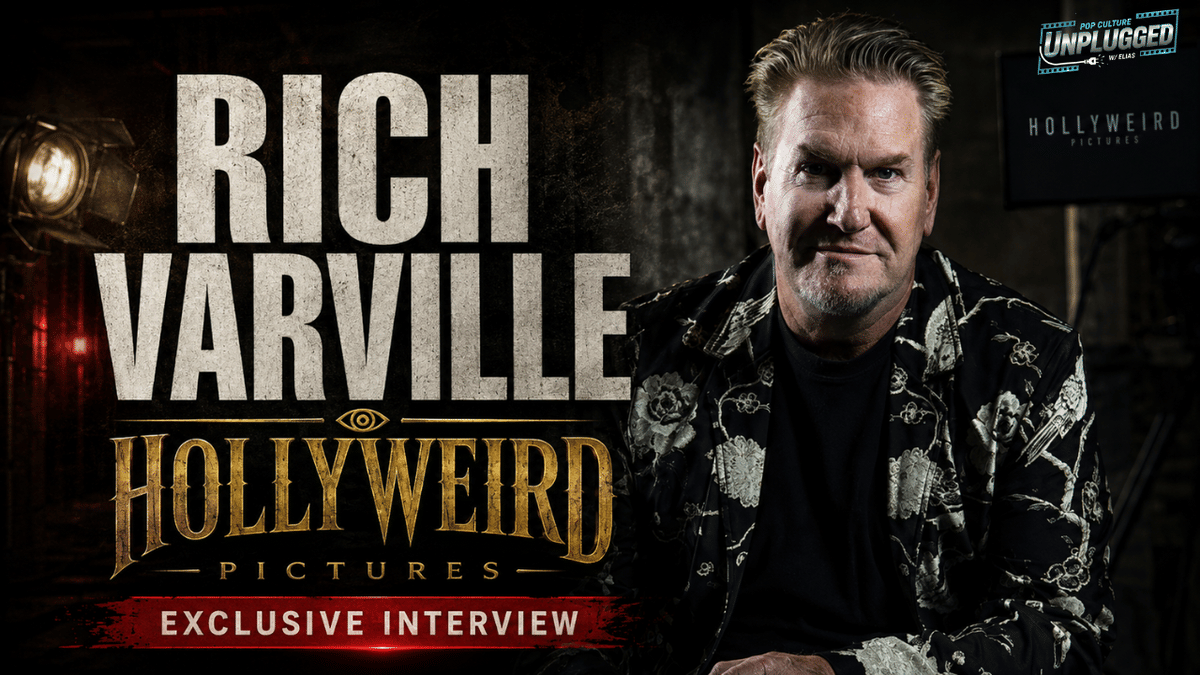
Exclusive Interview • Film
Rich Varville Is Ready to Make Hollywood a Little Weirder
The three-time Emmy winner opens up about launching HOLLYWEIRD PICTURES, the unsettling mythology behind AREA 1, and why the most powerful fear is always personal.
After more than 25 years in production and 15 years as a filmmaker, Rich Varville is stepping into a new chapter with HOLLYWEIRD PICTURES™, an independent production company focused on psychological thrillers, horror and stories that live just outside the Hollywood norm. Its first feature, AREA 1, turns a commemorative tattoo into the gateway to a hidden facility, a dark chapter of American history and a harrowing test of survival. Varville spoke with Pop Culture Unplugged about the company’s origins, the film’s New Mexico setting and the distinctly human fears beneath its unsettling premise.
After more than 25 years working in production and 15 years as a filmmaker, what made this the right moment for you to launch HOLLYWEIRD PICTURES and put your focus on original feature films?
I’ve been working toward this stage of my career for many years. I wanted to reach a point where I had the experience, the creative confidence and the right people around me to build something that could last.
Winning three Emmys this year was an incredible milestone, but it also felt like confirmation that the timing was right. HOLLYWEIRD PICTURES™ gives me a home to focus on what I’ve ultimately been building toward... original feature films, particularly thrillers, horror and stories that are a little outside the lines.
I’m not reinventing myself. I’m taking everything I’ve learned and putting it toward the work I’ve always wanted to do.
I have to ask about the name HOLLYWEIRD PICTURES — where did that come from, and what does the name represent about the kinds of movies you want the company to make?
“Hollyweird” has been part of my vocabulary for as long as I can remember. Back in my long-haired rockstar days, whenever my bandmates and I made the trek to the Sunset Strip, we’d say we were going to “Hollyweird.” So the name has actually been part of my life for decades.
When it came time to create a home for my films, it just fit. HOLLYWEIRD PICTURES™ represents the kinds of movies I love to make: psychological thrillers, horror and stories that are a little outside the Hollywood norm, but always grounded in something human. I want to entertain people, make them feel something and, hopefully, leave an impression that stays with them long after the credits roll.
AREA 1 has such an intriguing setup: a group of friends wake up trapped inside a hidden facility after a commemorative tattoo mysteriously leaves them paralyzed. Where did that idea first come from, and what was the piece of the story that made you realize, “I have to make this movie”?
The idea actually started with the tattoo. I loved taking the idea of something people associate with identity, friendship and permanence, and turning it into the thing that puts these women in danger.
From there I started asking, “What happens after they wake up?” That led me to the hidden facility and the larger mythology of AREA 1. But what made me realize I had to make this movie was the human story underneath it.
At its core, AREA 1 is a test of human endurance and survival instinct. These women are pushed physically and emotionally beyond anything they could have imagined, and the relationships between them are tested in ways that reveal who they really are. What are you capable of when someone you love is depending on you?
That’s where the movie became much more interesting to me than simply escaping a terrifying place. The horror creates the pressure, but the people and what they’re willing to endure for each other are the story.
Without giving away too much, what can you tell us about the mystery behind AREA 1 and the disturbing connection this facility has to America’s past?
What I can say is that AREA 1 has been there for a very long time.
The mythology reaches back to World War II and a period in American history when fear, secrecy and scientific ambition sometimes blurred the lines of morality. The facility was created for a purpose that was never meant to become public, and although the world moved on, AREA 1 didn’t necessarily disappear with it.
I love taking pieces of real history and building fiction into the spaces where we don’t know exactly what happened. There are enough disturbing things in our actual past that you don’t have to stretch very far before the fictional version starts feeling possible.
That’s part of what I want the audience wondering throughout the film: How much of this could actually have happened?
New Mexico seems like the perfect setting for a story involving secret facilities, history, and unexplained mysteries. How important is the location to AREA 1, and are there any real New Mexico stories or legends that helped inspire the world you’re creating?
New Mexico is almost a character in the film. There’s something about that landscape that feels beautiful, isolated and a little unsettling at the same time. You can look across miles of desert and genuinely believe there are things out there nobody knows about.
The state also has this incredible intersection of real history and mystery. You have White Sands, the Trinity nuclear test, Los Alamos, Roswell, military installations and decades of government secrecy all woven into the cultural mythology of New Mexico.
AREA 1 plays in that space between documented history and legend. We’re not trying to retell any one event. We’re taking that history, asking a few uncomfortable “what if?” questions, and creating our own mythology around it.
New Mexico gives the story something I don’t think we could manufacture anywhere else. It makes AREA 1 feel like maybe, just maybe, this place could actually exist.
You’ve said that “fear is most powerful when it’s personal.” How does that philosophy come into play with the characters in AREA 1? Is the biggest threat necessarily what’s inside the facility, or are the characters also going to be battling their own fears and secrets?
Absolutely. What interests me about fear is that it’s different for everyone. Put four people into the exact same terrifying situation and they’re going to experience it in four completely different ways.
That’s very much part of AREA 1. Each character brings her own history, relationships and emotional baggage into the story, so what frightens one of them may be completely different from what frightens another.
And fear changes people. Some people fight, some freeze, some become incredibly focused, and sometimes people discover a strength they didn’t know they had.
That’s what I mean when I say fear is most powerful when it’s personal. The horror can create the circumstances, but I’m much more interested in what fear reveals about the person experiencing it.
You’ve worked as a writer, director, producer, editor, and cinematographer. When you’re developing something like AREA 1, do all of those different parts of your brain start working at once, or do you have to separate the writer from the director and editor until later?
They’re definitely all working at once, whether I want them to or not. I tend to see the movie in my head as I’m writing it. I’m thinking about performance, camera placement, sound, rhythm and sometimes even where the edit might happen.
But I try not to let the filmmaker overpower the writer. Story and character have to come first. A beautiful shot means nothing if the audience isn’t emotionally invested in what’s happening inside it.
The advantage of having worked in so many areas is that I understand how those pieces ultimately have to come together. I’m not just writing scenes. I’m building the experience I eventually want the audience to have.
Horror audiences have become very good at recognizing the usual scares and tropes. What do you think it takes to genuinely surprise or unsettle an audience today without relying on jump scares or shock value?
I think audiences are much smarter than we sometimes give them credit for. They know the setups, they recognize the music cue, and they can usually tell when a jump scare is coming.
For me, the most effective horror comes from anticipation and loss of control. There’s something deeply unsettling about realizing that your choices are no longer entirely your own, or that someone else may have control over what happens to you.
I’m much more interested in creating that kind of dread than simply making someone jump out of their seat. A jump scare lasts a second. The feeling of helplessness can stay with you.
If I can make you uncomfortable in a brightly lit room with nothing hiding in the corner, that’s much more interesting to me.
AREA 1 is only the beginning of what you’ve described as an expanding slate for HOLLYWEIRD PICTURES. Is there anything you can tease about what you want to explore after AREA 1, and could these films potentially share a larger universe or connection?
AREA 1 is definitely the beginning. Another project I’m developing is DEATHBED, a psychological thriller about a criminologist who begins to suspect that her father, a legendary crime novelist, may have based his books on real murders. It’s a very different story from AREA 1, but it lives in that same uncomfortable world where you start questioning what you believe.
I’m absolutely open to building a larger universe around these films. I’m fascinated by conspiracy theories, dark myths, dreaded tales and strange corners of history that make you wonder, “What if there’s some truth to this?”
They don’t all need to be directly connected, but I love the idea of subtle threads, recurring mythology and things audiences might discover from one film to another.
We also have several other ideas in development that we’ll start talking about in 2027 and beyond. The goal is to build a slate that feels distinctly HOLLYWEIRD. If it’s dark, strange, a little unsettling and makes you question what you thought you knew, it probably belongs here.
Years from now, if you look back at the launch of HOLLYWEIRD PICTURES as the beginning of something much bigger, what do you hope audiences will say made a “HOLLYWEIRD PICTURES movie” different from everything else out there?
I really respect companies like Blumhouse, A24 and Shudder because they’ve built identities that audiences recognize. You see the name and it means something. I’d love for HOLLYWEIRD PICTURES™ to eventually earn that kind of recognition, but with an identity that is distinctly our own.
I want a HOLLYWEIRD movie to have a certain DNA. Strong characters, psychological tension, uncomfortable situations and stories that aren’t afraid to get strange. Conspiracy theories, dark mythology, disturbing pieces of history and ideas that make you question what might actually be possible all fit into that world.
But underneath all of it, there has to be something human. I want you invested in the people, not just the premise or the scares.
Ultimately, I want HOLLYWEIRD PICTURES™ to become a name audiences associate with movies that challenge their comfort zone, play with their expectations and make the strange feel just possible enough to be unsettling.