
Television • Cast Spotlight
June Laporte on American Hostage: Ginny’s Breaking Point & Working With Jon Hamm
From researching 1970s radio journalism to navigating a fractured newsroom, Laporte opens up about finding the voice of Ginny Hughes.
By Elias Giannakopoulos | Pop Culture Unplugged w/ Elias
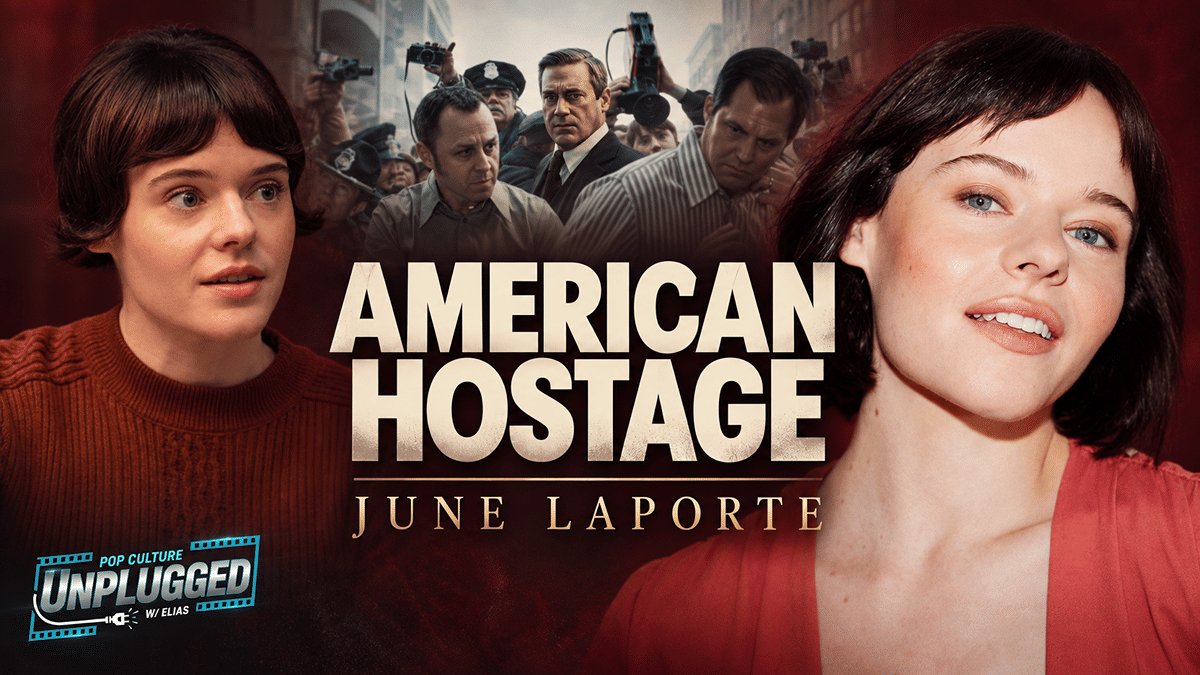
June Laporte joined Elias on Pop Culture Unplugged to discuss American Hostage, their approach to playing Ginny Hughes, and the professional and personal stakes surrounding a journalist determined to get her story heard. They also reflected on working with Jon Hamm, the tension of Episode 3, and their growing interest in stepping behind the camera.
Spoiler note: This article and the interview discuss events through Episode 3 of American Hostage.
Finding a Way Into Ginny’s World
For Laporte, the appeal of Ginny extended beyond the period costumes and the atmosphere of a 1970s newsroom. The role offered an opportunity to explore the barriers facing a woman working in radio journalism—and the pressure to prove herself in a profession where recognition could be hard to earn.
Laporte described Ginny as earnest, prepared, and ambitious. Those qualities helped them connect with a character whose commitment to the work becomes inseparable from her desire to finally tell a story of her own.
“I love research. I'm a big old nerd.”
— June Laporte
That enthusiasm shaped their preparation. Laporte listened to the American Hostage podcast during the audition and callback process, explored archival footage of the historical event, and investigated what radio journalism courses in Indianapolis might have looked like at the time. The goal was to understand both the unfolding crisis and the professional principles Ginny would bring into it.
Episode 3 Puts Trust to the Test
Ginny initially sees Fred as a mentor, but Episode 3 complicates that relationship. His decision to kill her story creates a collision between journalistic independence, the urgency of the crisis, and her own investment in the work.
Laporte distinguished their perspective as an actor from Ginny’s immediate response. They can understand the difficult position Fred occupies, while recognizing why Ginny feels so strongly about a story she has taken a significant risk to pursue. The fallout leaves a disconnect within the newsroom team.
Whether that trust can be rebuilt remains a question for the episodes ahead. For Laporte, the conflict is also part of a broader journey toward Ginny becoming more confident in her own judgment and voice.
Watch the Full June Laporte Interview
June Laporte discusses Ginny Hughes, Episode 3, working with Jon Hamm, and their next creative ambitions.
Building a Newsroom With Jon Hamm
A week of rehearsals before filming gave Laporte and their castmates time to establish the newsroom’s relationships. Working together on the set helped them create the sense of a team with an existing history.
Laporte spoke warmly about Hamm’s generosity and the trust they felt from the production’s leadership. Watching his ease as a performer and his command of the story became a source of inspiration. The experience also echoed Ginny’s place within the newsroom: a younger member learning from people whose work she respects.
They also praised Giovanni Ribisi’s portrayal of Tony, discussing how his performance brings nuance to a person shaped by trauma and difficult circumstances. That complexity informed Laporte’s own emotional response to the character.
Ginny Hughes Finds Her Voice
Asked to describe Ginny’s arc without revealing what comes next, Laporte focused on confidence: confidence in her voice, in herself, and in her ability to get and tell a story.
“I'm really excited for folks to see the very last episode.”
— June Laporte
Laporte singled out Episode 3 as an important chapter for Ginny while expressing enthusiasm for how the finale brings the story’s moving pieces together. They kept the specifics under wraps, leaving viewers to discover where that growing confidence will take her.
From Theater to the Director’s Chair
Before discussing the series, Laporte reflected on a childhood love of storytelling that led from books and backyard performances to dance and theater. They credited stage work with developing the stamina, preparation, and professionalism they now bring to film and television.
Their next creative challenge is directing. At the time of the conversation, Laporte was in post-production on a short film they had directed and was eager to keep developing that skill. They also mentioned an acting project they could not yet announce, with more opportunities ahead both in front of and behind the camera.