
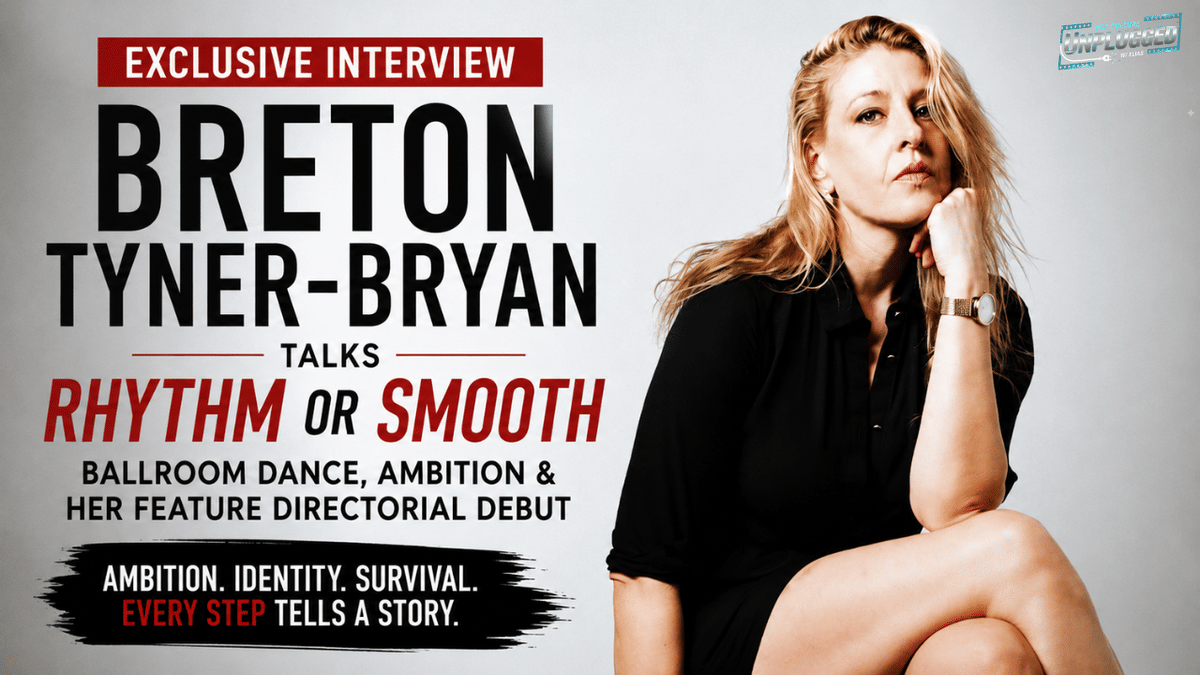
Breton Tyner-Bryan Talks Rhythm or Smooth, Ballroom Dance, Ambition & Her Feature Directorial Debut
Breton Tyner-Bryan joins Pop Culture Unplugged w/ Elias for a written interview about Rhythm or Smooth, her feature directorial debut set within the competitive and visually expressive world of ballroom dance.
Rhythm or Smooth explores ambition, class, artistry, and survival within the ballroom dance world. What first inspired you to tell this particular story, and why did this feel like the right time for your feature directorial debut?
I've always been fascinated by the relationship between ambition and identity. As a former professional ballet dancer, I spent years in environments where excellence, beauty, discipline, and status were deeply intertwined. Rhythm or Smooth grew from my interest in examining what happens when people build their sense of worth around achievement and external validation.Ballroom dance became the perfect backdrop because it is simultaneously glamorous and deeply competitive. Beneath the sequins and spectacle are questions about class, desire, power, and belonging. The film follows characters who are all reaching for something they believe will complete them, whether that's success, love, security, or recognition. This felt like the right time for my feature directorial debut because it brought together so many aspects of my creative life: movement, performance, visual storytelling, comedy, drama, and character psychology. It was the story I felt most compelled to tell and the one that required everything I had learned up to this point.
Ballroom dance has such a visually expressive and emotionally charged language. How did your background in choreography and movement storytelling influence the way you approached directing this film?
Movement is my first language as an artist. Long before I directed films, I was telling stories through choreography and performance. That background shaped every aspect of Rhythm or Smooth. I believe the body often reveals truths that dialogue cannot. Ballroom dance allowed us to externalize emotion, desire, status, and conflict through movement. Even in scenes without dancing, I approached performance, camera movement, and blocking as forms of choreography. My goal was to create a film where movement and storytelling were inseparable.
You wear multiple hats on this project as writer, director, and actor. What was the biggest challenge balancing all of those creative responsibilities during production?
The biggest challenge was the scale of what we were trying to accomplish within the time we had available. Many of our largest sequences involved elaborate choreography, multiple storylines, and more than one hundred performers and background actors on screen, yet some of those scenes had to be captured in a single day.What I love about filmmaking is that it combines artistry and problem-solving. The challenge wasn't simply wearing multiple hats. It was finding ways to preserve the emotional depth, visual ambition, and scale of the story while working within the realities of an independent production. Those constraints ultimately pushed us to be more creative and more precise in our storytelling.
Ava’s journey sounds deeply layered and emotionally complex. What drew you to her character arc, and what themes do you hope audiences connect with most through her story?
What fascinated me about Ava was her hunger. She is ambitious, intelligent, and determined, but she is also searching for validation and belonging. I think many people understand what it feels like to believe that success, love, or achievement will finally make them whole. Ava's journey explores questions of identity, class, self-worth, and the cost of ambition. I hope audiences see parts of themselves in her and reflect on what they are truly pursuing beneath their own ambitions.
New York City almost feels like a character itself in stories like this. How important was the city’s atmosphere and energy in shaping the tone and emotional stakes of Rhythm or Smooth?
New York was essential to the film. It is a city fueled by ambition, reinvention, and possibility. Every day, people arrive believing they can transform their lives, and that energy mirrors the emotional journeys of the characters. At the same time, New York can be isolating, competitive, and unforgiving. We wanted to capture both the excitement and the pressure of chasing a dream in a city that constantly demands more from you.
The film features both accomplished actors and elite real-world ballroom champions. What was the collaboration process like between the cast and professional dancers to make the performances feel authentic?
We were fortunate to work with world-class ballroom champions whose expertise brought tremendous credibility to the film. The collaboration became a genuine exchange. The actors learned from the dancers, while the dancers shared insights from years of competition and performance. Everyone was committed to honoring the reality of that world and portraying it with honesty, respect, and emotional truth.
Your previous projects like West of Frank, Bloom, and Delusione have been recognized internationally for their cinematic style and emotional storytelling. In what ways do you feel your creative voice evolved while making this feature?
Rhythm or Smooth is funny and heartbreaking, glamorous and uncomfortable, romantic and unsettling. Life rarely exists in a single tone, and I wanted the film to reflect that complexity. The experience reinforced my belief that visual style is most powerful when it serves character and emotional truth. In many ways, making Rhythm or Smooth felt both like an evolution and a return to my creative roots. My earlier films explored emotionally complex characters through highly visual storytelling, and that remains central to my work. But this feature allowed me to reconnect with something I have always loved, comedy.
Growing up, I was drawn to stories that could make audiences laugh while also revealing something deeper about human behavior. With Rhythm or Smooth, I had the opportunity to explore ambition, class, desire, and identity through a lens that is often funny, uncomfortable, and deeply human. I became more interested in allowing humor and drama to coexist rather than separating them. The experience reinforced my belief that life rarely exists in a single tone. The moments that move us most are often the ones that are simultaneously heartbreaking and hilarious, glamorous and messy. As a filmmaker, I've become increasingly interested in embracing those contradictions .
You’ve had an impressive career in front of the camera as well, appearing in projects like The Penguin, Manifest, and Billions. Has your experience as an actor changed the way you communicate with performers as a director?
Absolutely. Acting has given me a deep appreciation for the vulnerability required to create great performances. As a director, I try to create an environment where actors feel supported enough to take risks. I focus less on results and more on objectives, relationships, and emotional circumstances. My goal is to help performers discover something truthful rather than simply execute a predetermined idea.
Independent filmmaking can be incredibly demanding, especially on an ambitious production. Was there a particular moment during filming where you stepped back and realized, “We’re really making something special here”?
There were several moments, but one that stands out was watching our cast, crew, and ballroom champions come together during a major dance sequence. Years of writing, rehearsing, and preparation suddenly became real. Those are the moments that remind you why you endure the challenges of independent filmmaking.
Looking ahead, you have several exciting projects in development, including I Dream of Hazel and upcoming thriller projects. What kinds of stories or themes are continuing to inspire you most as a filmmaker moving forward?
I'm drawn to stories about transformation, identity, memory, and the ways people construct meaning in their lives. Whether I'm working in drama, thriller, science fiction, comedy, or musical storytelling, I'm interested in characters confronting the gap between who they believe they are and who they might become. I'm currently developing I Dream of Hazel, a television series that explores memory, perception, and time through a deeply personal and genre-driven lens. I'm also attached to direct There and Now by Academy Nicholl Fellowship-winning writer Andrew Shearer and The Scaffolder's Wife by Ryan Willer, while developing additional feature films, television projects, book adaptations, and musical adaptations with Grammy and Tony Award-winning collaborators. No matter the medium, I'm interested in stories that are emotionally honest, visually ambitious, psychologically layered, and rooted in the complexity of human experience.
Thank you again for your time, and congratulations on Rhythm or Smooth. We’re excited to follow the film’s journey and can’t wait for audiences to experience it.
Thank you so much! With gratitude, Bxx
Photo credit - ANKA GARBOWSKA