
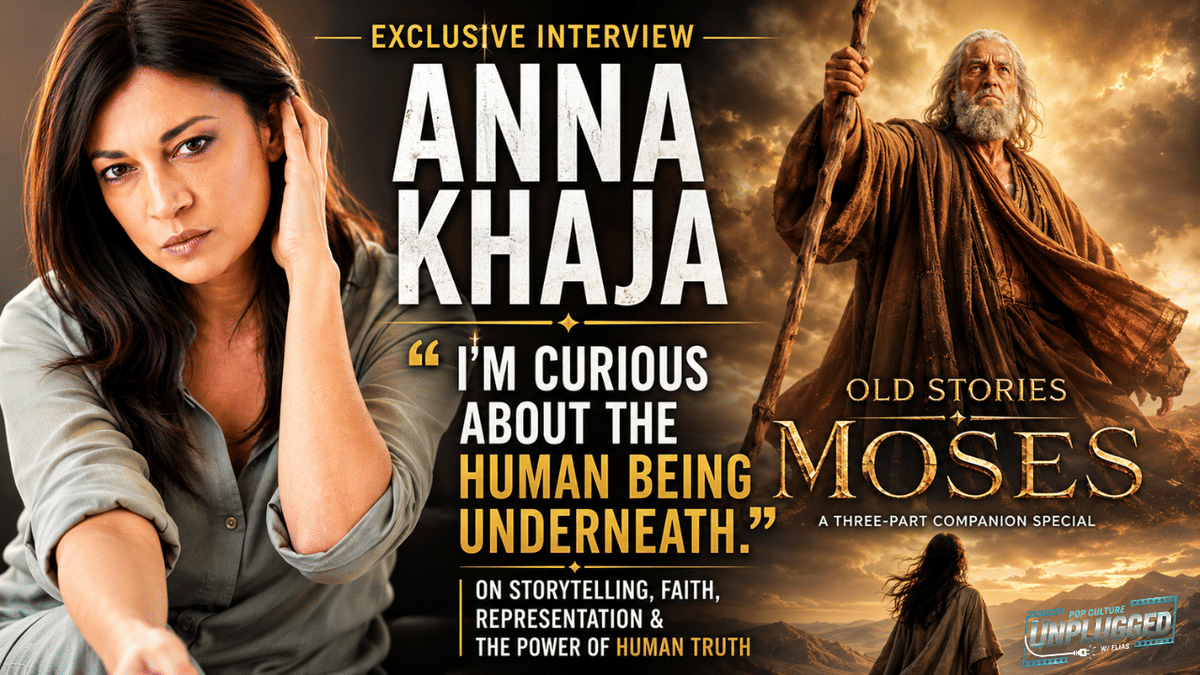
Pop Culture Unplugged Interview
Anna Khaja on Storytelling, Representation, HEADBANG, Old Stories, and Creating Space for Muslim Voices
Anna Khaja has built a multifaceted career across acting, writing, directing, and advocacy. In this written interview with Pop Culture Unplugged, she opens up about the driving force behind the stories she chooses to tell, her upcoming role as Zipporah in Old Stories, the global response to HEADBANG, and the importance of creating space for Muslim-rooted storytellers.
You’ve built such a multifaceted career across acting, writing, directing, and advocacy. When you look back at your journey so far, what has been the driving force behind the stories you choose to tell?
I'm curious about people who have been reduced to symbols, headlines, or stereotypes. I like exploring the human being underneath. I find myself returning to that impulse again and again.
I think a good example is my solo play Shaheed: The Dream and Death of Benazir Bhutto.
Benazir Bhutto, the former prime minister of Pakistan, was a really divisive figure. Some view her as a hero and a champion of democracy. Others see her as deeply flawed. What interested me wasn't proving either side right. It was trying to understand her as a human being living between those extremes.
Whether I'm acting, writing, or directing, I like exploring the contradictions, vulnerabilities, and unexpected truths that make someone fully human. Those are the stories that stay with me.
Your upcoming role as Zipporah in Old Stories places you in a project rooted in faith, history, and legacy. What drew you to the role, and what did you want to bring to the character emotionally and culturally?
Zipporah changed history but she's often mentioned in a sentence or two. The truth is, she was a woman who helped shape the trajectory of one of history's most influential figures. She was also the daughter of a respected spiritual leader herself. She came from a family that understood leadership, faith, and responsibility. So, when I looked at the character, I saw someone who possessed wisdom and perspective of her own.
What drew me to the role was the chance to play her as a fully realized person, which is how John Erwin wrote her (beautifully, I might add) . She has her own intelligence, her own convictions, her own emotional life, and her own influence on the events unfolding around her.
That was very appealing to me as an actor - to have the opportunity to humanize her and make her relatable to modern day audiences.
You’ve appeared in a wide range of projects from The Lincoln Lawyer to The Good Place and The Walking Dead: World Beyond. How have you seen opportunities for Muslim and South Asian performers evolve during your time in the industry?
When I started out, it sometimes felt like representation meant proving that we existed. There was often an unspoken expectation that a character had to somehow represent an entire community. What excites me now is that we're starting to see more Muslim and South Asian characters who are allowed to just be people.
They're funny and flawed. They're ambitious and messy. They make good decisions and bad ones. In other words, they're human.
That's important because I think stories are one of the most powerful antidotes to othering. The more fully human a character is, the easier it becomes to recognize ourselves in them. And when that happens, the distance between "us" and "them" starts to shrink. That's where storytelling can be transformative.
Do you ever feel pressure carrying the responsibility of representation, and how do you protect your own creative voice while also knowing your work means so much to so many people?
When you're part of a community that hasn't always seen itself reflected on screen, it's natural to be aware that people may attach a lot of meaning to your work.
But I try to remind myself that my responsibility isn't to represent everyone correctly. That's impossible. No one person can represent 2 billion Muslims, or every South Asian experience, or every woman, for that matter.
What I can do is approach the work with respect, curiosity, and honesty. I can tell my truth as faithfully as I know how and create characters that feel real to me. That's all any artist can do.
HEADBANG has already made an incredible impact on the festival circuit. What inspired the story, and what has surprised you most about the audience response around the world?
What has surprised me most is how universal the response has been. We've screened the film all over the world, and people consistently connect to it even when they have no connection to Islam or Muslim culture. Audiences see themselves in that struggle to figure out who they are, separate from family expectations, cultural expectations, or society's expectations.
That has been incredibly moving because it reinforces something I believe deeply: the more specific a story is, the more universal it can become.
With HEADBANG resonating globally and screening at major festivals, did that response change the way you view yourself as a filmmaker moving forward?
As a filmmaker, there's always a temptation to second-guess yourself. Watching HEADBANG resonate with people from so many different backgrounds reminded me that specificity isn't a limitation. In many ways, it's a strength.
So I don't know that it changed me as much as it gave me permission to trust my instincts more. It encouraged me to keep telling the stories that feel urgent and authentic to me, even if they're not the stories that conventional wisdom would describe as universal.
As someone who writes, directs, and performs, how does your perspective as an actor influence the way you approach storytelling behind the camera?
Being an actor has taught me that performances can't be forced. You can't command someone into being truthful.
So when I'm directing, I focus less on controlling the outcome and more on creating the conditions for something authentic to happen. I try to build trust, give actors room to explore, and stay open to being surprised.
Some of the best moments aren't planned. They're discovered. That's something I hope to carry with me as I direct more.
You’ve spoken about redefining Muslim representation in Hollywood. What are some of the stereotypes or limitations you still hope the industry moves beyond in the coming years?
Muslims are nearly two billion people living all over the world. There isn't a single Muslim experience, a single Muslim viewpoint, or a single way of moving through the world. I'd love to see that reality reflected more often on screen.
The goal isn't to replace one stereotype with another or to only tell positive stories. It's to create enough stories that no single character has to carry the weight of representing everyone.
To me, that's what progress looks like.
Your theater background is incredibly extensive, including your acclaimed work Shaheed: The Dream and Death of Benazir Bhutto. How has live theater shaped you differently as an artist compared to film and television?
I think theatre taught me to value presence over perfection. Every performance is different. Things go wrong. You have to listen, adapt, forgive yourself when you mess up, and try to stay connected to the people in front of you.
It also teaches stamina. When you're doing eight shows a week, you can't wait for inspiration to strike. You have to show up, do the work, and find a way to be fully present night after night. And, keep discovering new things in material you've already performed dozens of times.
Through Silver Thread, you’re helping create opportunities and community for Muslim-rooted storytellers. Why was it important for you to help build that kind of space within the entertainment industry?
For me, Silver Thread is about building infrastructure.
There is no shortage of talented Muslim artists. What sometimes feels scarce are the resources, relationships, visibility, and opportunities that help move projects and careers forward.
There are already some wonderful organizations supporting Muslim creatives, and we're proud to be part of that larger ecosystem.
Our motto is "brave." We gravitate toward stories that challenge assumptions and expand the conversation around what it means to be Muslim today.
There are so many misconceptions about Muslims in our culture and media. I don't think the answer is lecturing people. I think the answer is better stories.
Winning fellowships and recognition from organizations like the Black List and Screencraft is a huge accomplishment. How have those experiences impacted your confidence and momentum as a creator?
I'm super grateful for those recognitions. Writing can be a lonely process. So, when organizations respond to my work, it encourages me to keep going.
And the accolades have helped create momentum and opened doors for me, which I'm thankful for. That said, every new project still starts with a blank page, and I still feel like I have so much to learn!
Looking ahead, what kinds of stories or characters are you most passionate about bringing into the world next — either as an actress, filmmaker, or writer?
I want to see people who aren't usually protagonists be protagonists.
I like shifting the lens a little bit and asking, "Whose story haven't we heard?" Or whose story have we misunderstood?
Those are usually the stories that pull me in.